Monday, 2 April 2012

Earthquake-Resistant Building Design

This is based on a piece of HW and is my own research..there are lots more you can find out for yourself though! :)


Earthquake Resistant Building Design

Taipei 101

The Taipei 101 is located in Taipei, Taiwan. It started construction in 1999 and was completed in 2004. It is 101 stories above ground and 5 stories below. It is 509.2 meters tall.

1.      The design of this building achieves strength and flexibility through the use of high performance steel construction. Taipei 101 is supported by 36 columns, as well as 8 ‘mega columns’ made with 10,000 psi (pounds per square inch-a unit of pressure) concrete.

2.      Every 8 floors, outrigger trusses connect columns in the building’s core to those on the exterior. This makes it one of the most stable buildings in the world.

3.      The foundation of the Taipei 101 is very strong. It has 380 piles 80 meters deep in the ground, it extends as far as 30 meters into the bedrock. Each pile is 1.5 meters in diameter and can withstand a load of 1,000-1,320 tonnes.

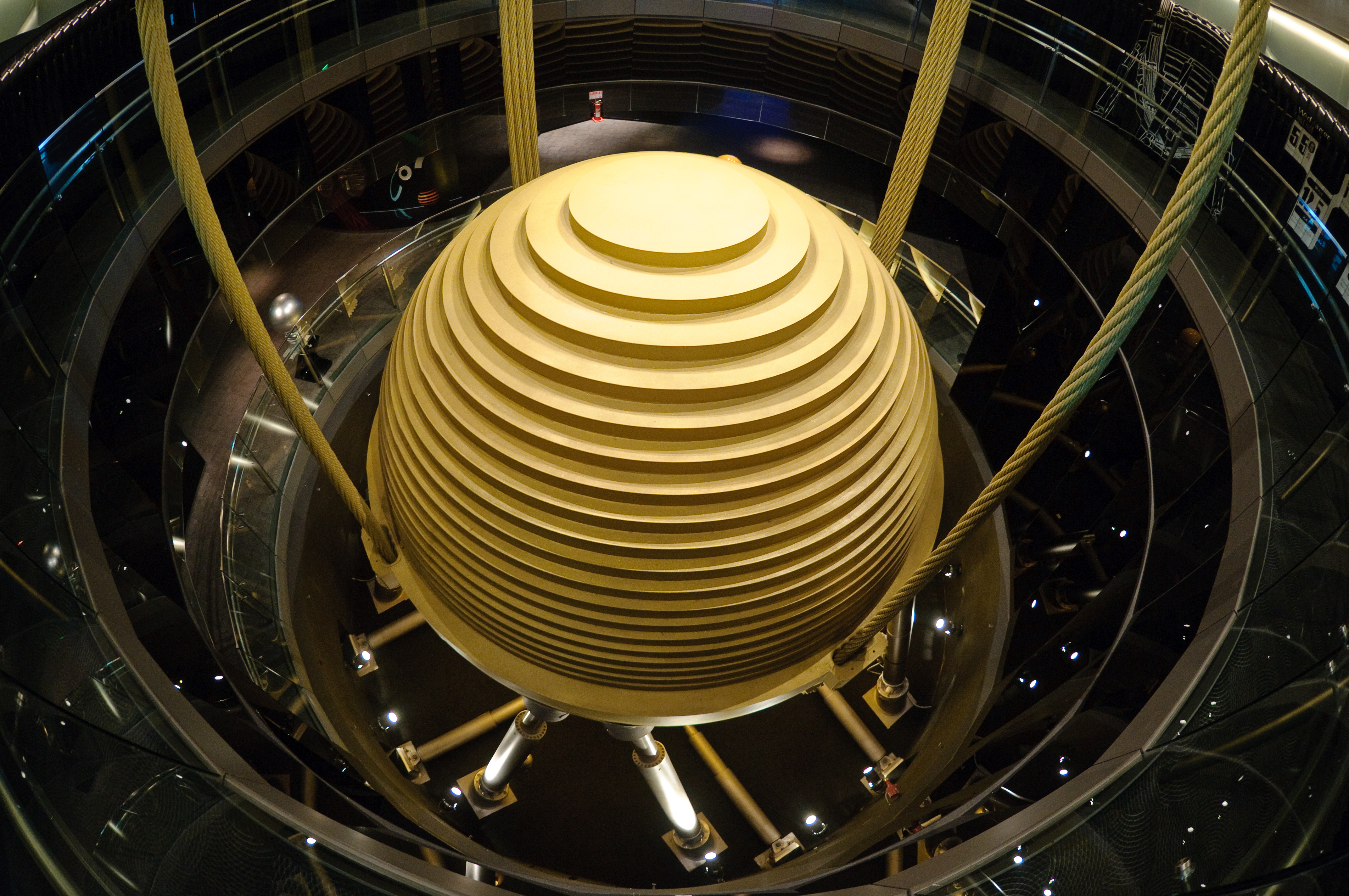
4.      One interesting feature of the Taipei 101 is its steel pendulum. It serves as a tuned mass damper that weighs 660 tonnes. It cost US$ 4 million. It is suspended from the 92nd to the 88th floor and can be viewed. It is computer controlled, if the building sways to one side due to strong winds or seismic waves, it goes in the opposite direction. It offsets the movement of the building. This keeps the building balanced and prevents it from being top-heavy and collapsing.

5.      The blue-green glass are double paned and glazed. They offer heat and ultraviolet protection and can block external heat by up to 50%. It can sustain impacts of 7 tonnes.
Tuned Mass Damper


Torre Mayor

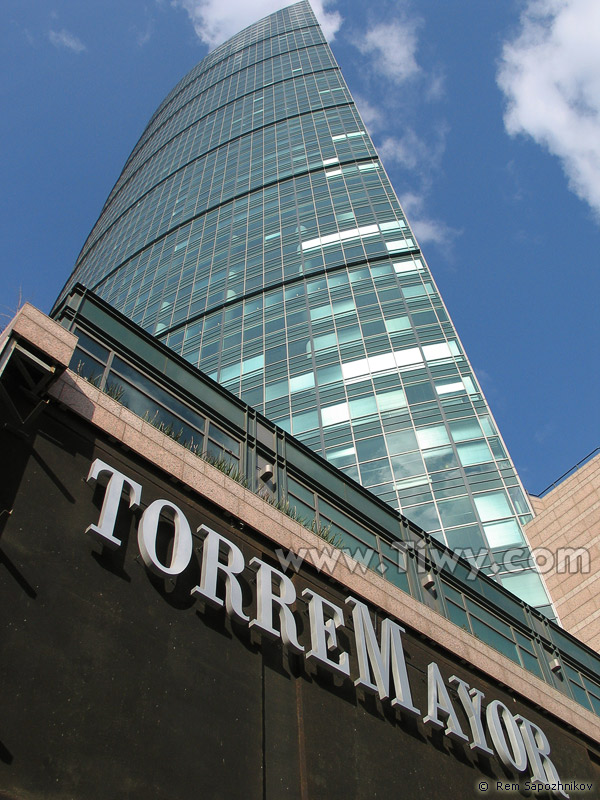
The Torre mayor is in Mexico City. It started construction in 1999 and was finished in 2003. It has 57 stories and is 225 meters tall.
It uses large Fluid Viscous Dampers as a primary means of seismic energy dissipation. There are a total of 98 dampers, 24 of which are large; each rated at 570 tonnes output force. They are located in the long walls of the building. The short walls have 74 smaller dampers, each rated at 280 tonnes output force. The dampers are installed in mega brace elements, up to 20 meters in length. A single damper can span up to six floors.
http://science.howstuffworks.com/engineering/structural/smart-structure.htm

Earthquake Isolated Base Technology

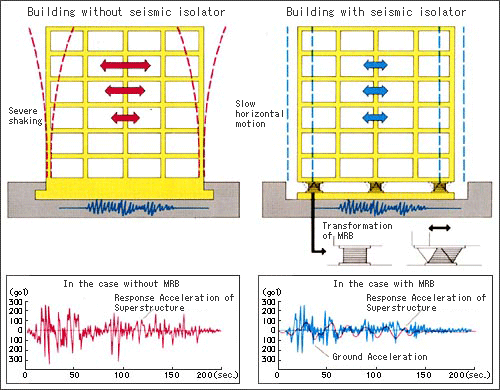
This technique uses a coil or any other flexible support placed in between the structure's foundation. There is a movement interaction with the seismic waves, thus if the earthquake moves the foundation in one direction, the support will move the opposite direction and this confers immobility to the building. Some modern building are incorporated with cross-supports in between frame support, these also hold building together during tremor.


Was this useful?


Reducing Impacts of Earthquakes

Prediction
  • Currently impossible to predict when an earthquake will happen. But if you can, it would give people time to evacuate which would reduce the number of injuries and deaths.
  • There can be clues that an earthquake is about to happen, such as lots of small tremors, cracks appearing in rocks and strange animal behaviour (e.g. rats abandoning nests). 
  • It's possible to predict where future earthquakes may happen using data from past earthquakes e.g. mapping where earthquakes have happened shows which places are likely to be affected again,  or where there is a gap where there haven't been major EQs along a fault line there is a probability of an earthquake occurring there-these places can prepare themselves for the impacts of an earthquake. 
Building techniques
  • Buildings can be designed to withstand earthquakes. e.g. by using materials like reinforced concrete or building special foundations that absorb an earthquake's energy. 
  • Constructing earthquake-resistant buildings reduces the number of buildings destroyed by an earthquake, so fewer people will be killed, injured, made homeless and made unemployed. See post on 'Earthquake-resistance Building Design'.  
Planning
  • Future developments, e.g. new shopping malls, can be planned to avoid the areas most at risk from earthquakes. This reduces the number of buildings destroyed by an earthquake. 
  • Firebreaks can be made to reduce the spread of fires. http://www.ehow.com/facts_6857140_firebreak-made_.html
  • Emergency services can train and prepare for disasters, e.g. by practising rescuing people from collapsed buildings and by stockpiling medicine and other equipment. This reduces the number of people killed.
  • Governments can plan evacuation routes to get people out of dangerous areas quickly and safely after an earthquake. This reduces the number of people killed/injured by things like fires. 
Education
  • Governments and other organisations can educate people on what to do in the case of an earthquake. (e.g. stand in a doorway) and how to evacuate. This reduces deaths. --Schools and companies should practise earthquake drills regularly. 
  • People can be told how to make a survival kit containing things like food, water, a torch, a radio and batteries. The kits reduce the chance of people dying if they're stuck in the area. 
Aid
  • Poorer countries that have been affected by earthquakes can receive aid from governments or organisations-it can be things like food, water, money or service people (e.g. doctors/rescuers)
  • Aid helps to reduce the impacts, e.g. money-aid is used to rebuild homes, reducing homelessness. 

Was this useful?

Sunday, 1 April 2012

Shanty Town Model Answer

For a named city in an LIC, explain the management strategies being used to minimise the problems of its shanty towns (squatter communities)                                                                                                         (9m)

This answer should get 8-9 marks, and is based on my own research and what I wrote in a unit test. Please refer to a previous post 'Shanty Towns' and 'Shanty Town Case Study: Sao Paulo's Favelas' for more information to help you develop your own answer. :) 

Name of city: Sao Paulo, Brazil

Sao Paulo has around 2500 favelas including Jaguare, Heliopolis and Paraisopolis. Many improvements have been made to these shanty towns. There are site-and-service schemes where government or non-governmental organisations (NGOs) provide building materials for the locals to build a better home on their land. Once built, city authorities would help install basic amenities like electricity, running water and sanitation. This reduces the number of people illegally hooking up to overhead electricity lines and improves health as people have access to clean water for cooking and washing. With sewage systems the chances of diseases spread is also minimised. There are microlending schemes where locals can apply for small loans to finance their businesses or to start a business. In Heliopolis a microcredit scheme was developed by a non-profit US organisation and the Brazilian government where locals with small businesses can apply for loans between $100-$1500. Tenure is used where help has been given to locals so they have legal rights over their homes and land, so they are more secure. In Jaguare for example, there is a strong neighbourhood association where people in the favela have worked together to persuade the government to reduce crime and offer people, especially children, a wide range of sport or other activities. They also helped provide better infrastrcuture with better roads, more recreational facilities, especially for children. There are charity projects so other wealthier people volunteer to teach the shanty locals basic hygiene. Through medical associations healthcare has also been made more accessible so there is more of a chance of diseases cured and longer life expectancy.Sao Paulo also has edge cities developing like Jardines which may encourage rural-urban migrants to live away from the main city, so there is less pressure in the shanty towns.

The full notes for Shanty Town Case Study: São Paulo Favelas is in my IGCSE Geo Notes Set which is up for sale! 
Contact: michelle.lim205@gmail.com